
Ever wondered what the 2016 emoji means or why people search for it online? Whether you found it in an old message, social media post, or emoji list, its meaning can be confusing at first. Understanding the context can help you use it correctly instead of guessing.
In this guide, we’ll explain what 2016 emoji refers to, how it may appear across different devices and platforms, and what people usually mean when they use it. You’ll also find simple examples and practical tips for using it in messages, captions, and online conversations.
Emoji designs and meanings can vary by platform, so the same symbol may look slightly different on iPhone, Android, WhatsApp, Instagram, or other apps. Let’s explore it clearly and find the right way to use it.
What Does “2016 Emoji” Mean?
The phrase 2016 emoji generally refers to emojis that were added or introduced through the major Unicode and Emoji updates released during 2016.
The first major update was Unicode 9.0, released on June 21, 2016. It included 72 new emoji characters. Unicode described additions across categories such as faces, people, hand gestures, animals, plants, food, sports, and other objects.
Later in 2016, Emoji 4.0 expanded emoji representation with professions and gender-specific versions. Many of these were created by combining existing emoji characters into sequences rather than adding completely new Unicode characters.
So, when someone searches for “2016 emoji,” they may be looking for either the Unicode 9.0 emoji list or the broader emoji developments that happened during 2016.
Popular Emojis Added
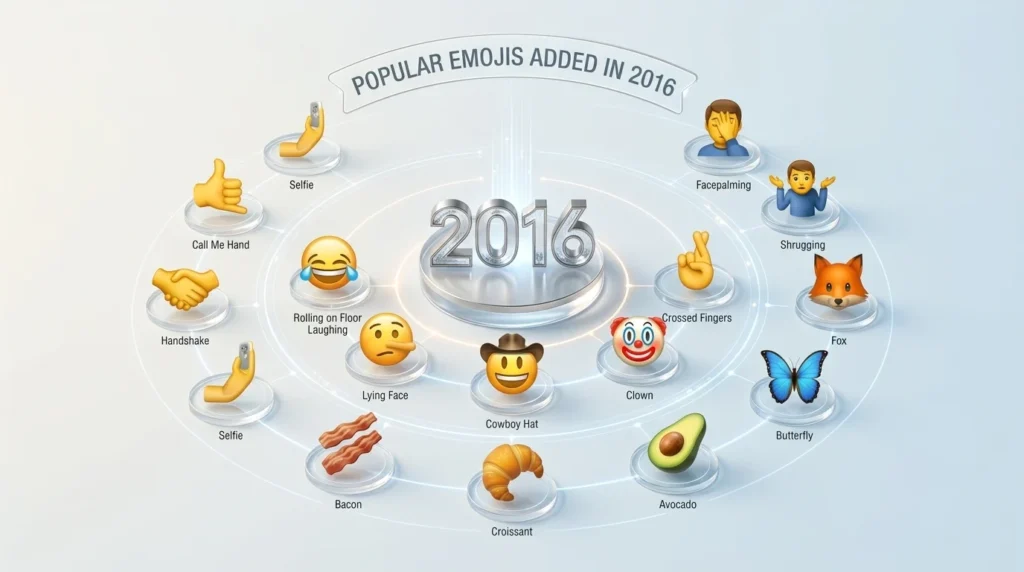
Here are some of the most recognizable emojis associated with the 2016 Unicode 9.0 release:
| Emoji | Name | Common Use |
|---|---|---|
| 🤣 | Rolling on the Floor Laughing | Something is extremely funny |
| 🤥 | Lying Face | Joking, lying, or being dishonest |
| 🤤 | Drooling Face | Desire, delicious food, or attraction |
| 🤢 | Nauseated Face | Feeling sick or disgusted |
| 🤧 | Sneezing Face | Cold, allergies, or sneezing |
| 🤠 | Cowboy Hat Face | Fun, confidence, Western theme |
| 🤡 | Clown Face | Humor, foolishness, or clowning around |
| 🖤 | Black Heart | Dark aesthetic, grief, or deep affection |
| 🤞 | Crossed Fingers | Hope, luck, or wishing |
| 🤙 | Call Me Hand | Calling, texting, or a relaxed greeting |
| 🤝 | Handshake | Agreement, teamwork, or friendship |
| 🤳 | Selfie | Taking a selfie |
| 🤦 | Person Facepalming | Frustration or disbelief |
| 🤷 | Person Shrugging | Uncertainty or “I don’t know” |
| 🦊 | Fox | Animals, cleverness, or nature |
| 🦋 | Butterfly | Nature, beauty, or transformation |
| 🥑 | Avocado | Food, healthy eating, or breakfast |
| 🥓 | Bacon | Food and breakfast conversations |
| 🥐 | Croissant | Breakfast, baking, or French food |
These examples come from the Unicode 9.0 emoji set released in 2016.
2016 Face Emojis and Their Meanings
The 2016 update brought several expressive faces that quickly became useful in everyday conversations.
🤣 Rolling on the Floor Laughing is used when something is exceptionally funny. It can express stronger laughter than a simple smiling or laughing emoji.
🤥 Lying Face represents lying, exaggeration, or a playful suggestion that someone is not telling the truth.
🤤 Drooling Face can describe wanting delicious food, being tempted by something, or showing strong desire in a playful context.
🤢 Nauseated Face usually communicates sickness, nausea, disgust, or an unpleasant reaction.
🤧 Sneezing Face is commonly associated with sneezing, a cold, allergies, or feeling unwell.
🤠 Cowboy Hat Face can add a playful, cheerful, adventurous, or Western-style mood to a message.
🤡 Clown Face may be used literally for a clown or figuratively for foolish, silly, or humorous situations.
Because emoji appearance can vary between platforms, the exact visual design may look different on Apple, Google, Microsoft, Samsung, and other systems.
2016 Hand and People Emojis
Another important part of the 2016 emoji update was the expansion of expressive hand and people emojis.
🤞 Crossed Fingers is commonly used when someone is hoping for good luck.
🤙 Call Me Hand can suggest calling someone, contacting them, or using a relaxed and friendly gesture.
🤛 Left-Facing Fist and 🤜 Right-Facing Fist can represent a fist bump or solidarity when used together.
🤝 Handshake is useful for agreement, cooperation, friendship, business, or teamwork.
🤳 Selfie represents taking or posing for a selfie.
🤦 Person Facepalming is useful when something feels frustrating, embarrassing, obvious, or unbelievable.
🤷 Person Shrugging often communicates uncertainty, indifference, or “I don’t know.”
These additions helped people communicate reactions and gestures without needing a full sentence.
Food, Animals, and Everyday 2016 Emojis
2016 also brought a large collection of emojis that made everyday conversations more visual.
Food additions included 🥝 kiwi fruit, 🥑 avocado, 🥔 potato, 🥕 carrot, 🥒 cucumber, 🥐 croissant, 🥖 baguette, 🥞 pancakes, 🥓 bacon, 🥚 egg, 🥗 green salad, 🥛 glass of milk, and 🥂 clinking glasses.
Animal and nature additions included 🦍 gorilla, 🦊 fox, 🦌 deer, 🦏 rhinoceros, 🦇 bat, 🦅 eagle, 🦆 duck, 🦉 owl, 🦎 lizard, 🦈 shark, 🦐 shrimp, 🦑 squid, 🦋 butterfly, and 🥀 wilted flower.
There were also additions such as 🛵 motor scooter, 🛴 kick scooter, 🛑 stop sign, 🛶 canoe, 🛒 shopping cart, and several sports-related emojis.
What Was Emoji 4.0 in 2016?
Emoji 4.0 was another important development in late 2016. It introduced 113 new emoji, with a major focus on gender representation and professions. Many were emoji sequences created by combining existing characters with a special invisible character called a Zero Width Joiner (ZWJ).
The update included professional roles such as astronauts, teachers, scientists, and other occupations in gendered forms. It also included family sequences and gendered versions of activities.
This explains why searching for “2016 emoji” can produce more than one list. The June Unicode 9.0 release and the later Emoji 4.0 update are both connected to the emoji developments of 2016.
Why Were the 2016 Emojis Important?
The 2016 updates expanded the ways people could express emotions, reactions, activities, food, animals, professions, and everyday experiences in digital communication.
Emoji are especially useful because a single symbol can add emotional context to a short message. For example, 🤣 can make a sentence clearly humorous, while 🤦 can communicate frustration without requiring a long explanation.
The 2016 releases also helped expand representation through new people, professions, and gendered emoji sequences. Unicode’s 2016 documentation specifically highlighted this broader representation.
Can I Still Use 2016 Emojis Today?
Yes. Many emojis associated with the 2016 updates remain part of modern emoji sets.
However, the way an emoji looks can change depending on the platform, operating system, application, font, or device. An emoji’s basic Unicode identity remains standardized, while companies can create their own visual artwork for displaying it.
This is why the same emoji may look slightly different on an iPhone, Android phone, Windows computer, or social media app.
How to Copy and Use 2016 Emojis
Using these emojis is simple. You can copy an emoji directly from an emoji list and paste it into supported apps.
For example:
Funny: 🤣 🤡
Hope & luck: 🤞
Call or contact: 🤙
Agreement: 🤝
Selfie: 🤳
Confusion: 🤷
Frustration: 🤦
Food: 🥑 🥓 🥐 🥞
Nature: 🦊 🦋 🦉
Celebration: 🥂
You can use them in messages, captions, comments, posts, and other supported digital communication.
FAQs
1. What is the 2016 emoji?
“2016 emoji” commonly refers to emojis introduced through major emoji updates in 2016, especially Unicode 9.0 and the later Emoji 4.0 release.
2. How many emojis were added in Unicode 9.0?
Unicode 9.0 added 72 new emoji characters. The update was released on June 21, 2016.
3. Which popular emoji came out in 2016?
Popular additions included 🤣 Rolling on the Floor Laughing, 🤥 Lying Face, 🤠 Cowboy Hat Face, 🤡 Clown Face, 🤞 Crossed Fingers, 🤝 Handshake, 🤳 Selfie, 🤦 Person Facepalming, 🤷 Person Shrugging, 🦊 Fox, 🦋 Butterfly, and 🥑 Avocado.
4. Was Emoji 4.0 also released in 2016?
Yes. Emoji 4.0 was released later in 2016 and added 113 new emoji, focusing heavily on professions, gender representation, and emoji sequences.
5. Why do the same 2016 emojis look different on different devices?
Unicode defines the underlying emoji characters, but individual platforms can design their own artwork. Therefore, the same emoji may have slightly different appearances across devices and apps.
Conclusion
The 2016 emoji updates were an important step in the development of modern digital communication. Unicode 9.0 introduced 72 new emoji characters, including expressive faces, gestures, animals, foods, sports, and everyday objects. Later that year, Emoji 4.0 expanded the emoji system with professions, gendered roles, families, and other sequences.
From 🤣 and 🤞 to 🦊, 🦋, and 🥑, many emojis connected with the 2016 releases are still familiar today. Understanding their names and common meanings can make it easier to choose the right emoji for messages, captions, comments, and social media .

Noah Bennett is a content specialist with a passion for internet culture, visual communication, and emojis. He enjoys researching popular symbols and sharing simple insights readers can use every day.